


"AI-Powered" is a Checkbox. Prediction is a Discipline

Our CTO went on the Stack Overflow Podcast to explain the difference. Here's what media buyers should take from it.
Every vendor pitch deck you've seen this year says "AI-powered." Our CTO, Frank Portman, recently sat down with the Stack Overflow Podcast to talk about what that label should mean, and why we built Yobi's prediction engine from scratch instead of bolting a language model onto an ad stack.
You don't need to write code to care about this. If you're planning media, here's the short version.
Great at conversation ≠ great at prediction
When most people say "AI," they mean Large Language Models (LLMs) and various chatbot products built on top such as ChatGTP. And ChatGPT is genuinely impressive at what it was trained to do: generate fluent, plausible language. Useful for writing copy. Useful for summarizing a brief.
But predicting whether a real person will convert, churn, or respond to an offer is a completely different problem. As Frank put it on the podcast, the training that makes a language model good at conversation was never designed for forecasting or decision-making. A lot of "AI-powered" vendors are quietly hoping you won't notice that gap.
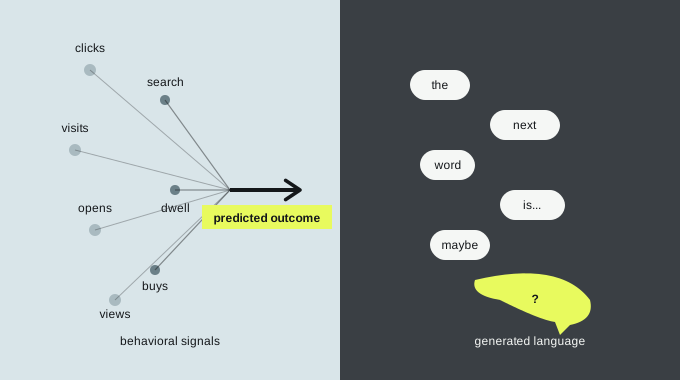
We built a foundation model of behavior, not a chatbot in a trench coat
Yobi's model was trained from the ground up on behavioral and transactional signals — not text scraped from the internet. In practice, that means three things:
It performs on campaigns it's never seen. The model learns underlying patterns of behavior rather than memorizing past outcomes, so it holds up on a brand-new product or campaign out of the gate.
It runs at advertising speed. Millions of decisions per second. A chatbot round-trip can't touch that latency, and live bidding doesn't wait.
It doesn't need demographics. Old-school targeting assumed you had to know who someone was — age, income, household — to predict what they'd do. Our models predict from behavior itself. Better performance, less personal data. That's not a trade-off; it's the design.
The performance gap is real
An LLM will confidently produce an answer even when it's filling gaps with plausible-sounding guesses. That's fine when the task is drafting an email. It's expensive when the "answer" decides where your media spend goes.
Yobi's advertising models exist to answer one question: what's the expected value of engaging with this consumer, in this context? Not to just sound right. To be right.
The question to ask your vendors
Not "do you use AI?" Everyone does, or says they do. The question is whether the AI they're using was ever built to do the job you're hiring it for. If they’re claiming to help with decision making and not just information synthesis, ask what proprietary data or modeling techniques back up that claim.
Yobi isn't a chatbot in an adtech wrapper or a legacy targeting stack with a new label. It's a foundation model built for one thing — predicting behavior — trained on real behavioral signal, privacy-preserving by design, and fast enough for the world advertising actually operates in.
Listen to the full conversation: Stack Overflow Podcast — Why Intent Prediction Needs More Than an LLM